
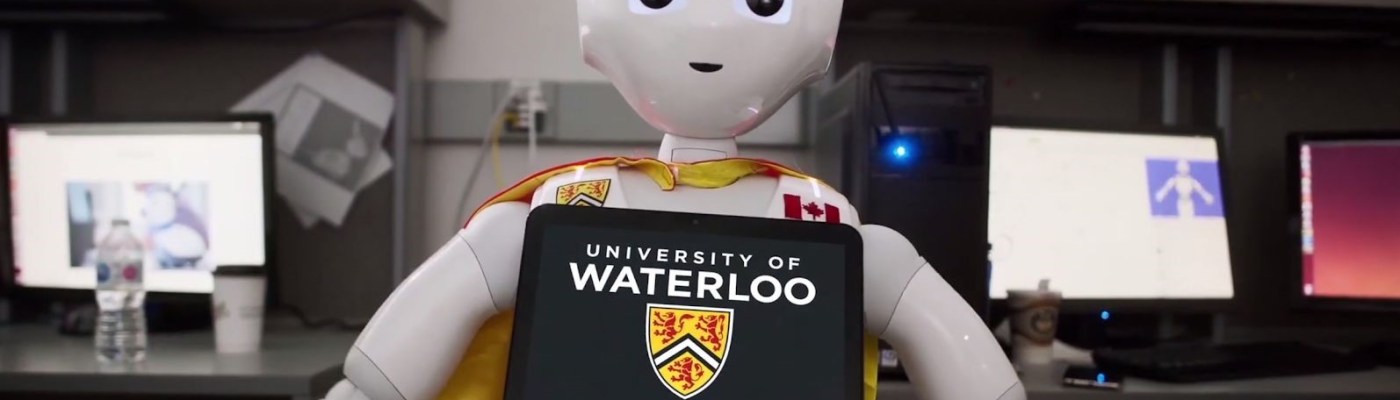
There are many exciting discoveries happening at the University of Waterloo. Waterloo is known as Canada’s most innovative universities, greatly due to the brilliant ideas their community members bring to reality. The combination of curiosity and rigorous inquiry leads to the makings of the next greatest invention or furthering the knowledge of the way things work. Waterloo conducts extensive research in the fields of social robotics, human-robot interaction, cognitive and developmental robotics and Embodied Artificial Intelligence.
But how can robots change the world? Keep Reading.
Social and Emotional Impact

“I am particularly interested in applications of companion robots in therapy and education for children, and supporting people with dementia living in long-term care facilities and elderly persons living at home independently,”
– Kerstin Dautenhahn, Co-founder of Social and Intelligent Robotics Research Laboratory at Waterloo
Kerstin Dautenhahn is one of the founders of the field of social robotics at Waterloo. Her extensive accomplishments include breaking new ground with robot-assisted therapy for children with autism, who often find communication and social interaction overwhelming and unpredictable. Play sessions with robots can have long-term benefits for a child because they learn social cues and can practice behaviour with the robot.
Healthcare Solutions

It began with “Hack4Health” in 2015, where three Waterloo science students learned that bedsores were a critical issue for healthcare in North America costing seven lives an hour and up to $20B every year. Zied Etleb, Moazam Khan and Matthew Sefati decided to tackle the problem and develop smart products to prevent and manage pressure wounds. The co-founders called their startup company Curiato Inc.
The innovative system retrofits to existing hospital beds, and uses advanced sensors to detect biological factors – like moisture and heat. AI analyzes the data and predicts the potential for wound development and other conditions, delivering this information to caregivers in real-time, via a digital interface. As a result, front-line care teams can prioritize procedures and increase quality of life for at-risk patients.
Humanitarian Initiatives

Most children take their first steps with a carefree excitement to explore the world around them. But for Cambodian children, potential danger lies hidden beneath every eager step. They’ve inherited a landscape cursed with landmines from years of deadly conflict.
Richard Yim grew up in Cambodia and experienced this first-hand. Yim co-founded Landmine Boys, a startup born out of a fourth-year mechanical engineering Capstone Design project. It promotes a safer alternative for neutralizing landmines than the current method of controlled explosion. Yim’s first robot was designed to defuse landmines without detonation or human interaction. The company, now called Demine Robotics, develops semi-autonomous machines that can locate, dig and remove a landmine while keeping humans at a safe distance.
“ We believe that in the future, our machines will be the factor that removes landmines from the ground, once and for all. ”
– Richard Yim
Together, We can Impact the World!
Science is borne out of curiosity — who’s more curious than children? At Kidzwhiz, we strive to nourish and elevate this curiosity. We equip your child with the technology fundamentals, while also fostering an environment that inspires them to think deeper about these skills and how they can connect them to our world. As a University of Waterloo Alumni himself, Matthew Chan, founder of Kidzwhiz, strongly believes that children are capable of grasping these concepts and achieving big things, and it’s our mission to help them get there.
Sources:
 https://uwaterloo.ca/global-impact/robot-social-being
 https://uwaterloo.ca/global-impact/landmines
 https://uwaterloo.ca/global-impact/medtech-startup-tackles-silent-epidemic
 https://uwaterloo.ca/global-impact/
 Kidzwhiz Blog